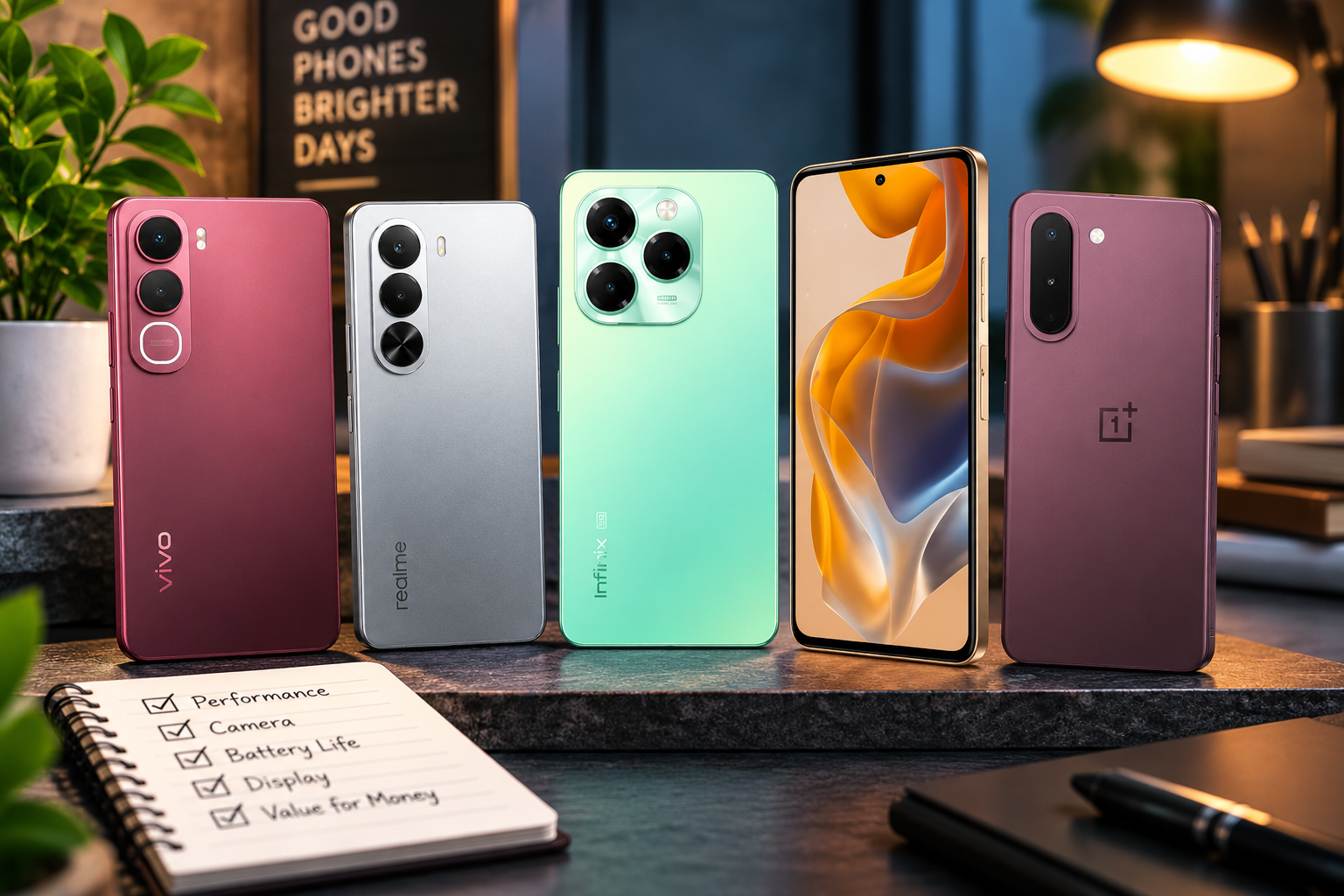
Best Smartphones Under ₹20,000 in India: What to Look for Before Buying
Buying a smartphone under ₹20,000 sounds simple.
Open an online store, filter the price to ₹20,000 and choose the phone with the highest specifications.
But there's a problem.
The phone with the biggest numbers isn't necessarily the best phone for you.
One smartphone might offer a better processor but an average camera. Another may have an excellent AMOLED display but slower charging. A third might have a huge battery but too much pre-installed software.
And then there are confusing specifications:
108MP camera. 120Hz display. 8GB RAM. 256GB storage. 5,000mAh battery.
What do these numbers actually mean?
In this guide, we'll explain how to choose the best smartphone under ₹20,000 in India, what specifications matter most, what you can safely compromise on, and the mistakes you should avoid.
Important: Smartphone prices, offers, specifications and availability change frequently. Always verify the current price and configuration before purchasing.
Quick Answer: What Makes a Good ₹20,000 Smartphone?
If you're buying a phone around ₹20,000, prioritize these features:
Look for:
- Good processor
- AMOLED display, preferably with a high refresh rate
- At least 6GB–8GB RAM
- 128GB or more storage
- Reliable primary camera
- Good battery life
- Fast charging
- Long software-support period
- 5G connectivity
- Good build quality
But don't choose a phone based on specifications alone.
Your priorities should depend on how you use your phone.
Best Smartphone Under ₹20,000: What Should You Prioritize?
Different users need different phones.
| User Type | Most Important Features |
|---|---|
| Student | Battery, display, performance |
| Gamer | Processor, cooling, display |
| Photographer | Camera processing, sensor, stabilization |
| Social Media User | Camera, display, battery |
| Business User | Battery, software, reliability |
| Heavy User | Processor, RAM, battery, storage |
| Casual User | Display, battery, software |
For example, a gamer shouldn't buy a phone simply because it has a 108MP camera.
And someone who mainly takes photos shouldn't automatically choose the phone with the fastest processor.
1. Processor: The Most Important Specification
The processor affects almost everything you do on your phone.
It influences:
- App performance
- Gaming
- Camera processing
- Multitasking
- Battery efficiency
- Video recording
- Overall responsiveness
This is why you should pay close attention to the chipset.
Don't Judge a Processor by the Number of Cores Alone
You might see:
Octa-core processor
and assume it's automatically powerful.
But many modern processors are octa-core.
What matters more is:
- CPU architecture
- Manufacturing process
- GPU performance
- Real-world optimization
- Thermal management
- Software optimization
Two octa-core processors can perform very differently.
2. How Much RAM Do You Need?
For a smartphone around ₹20,000:
6GB RAM
Good for:
- Normal social media
- Messaging
- Browsing
- Streaming
- Everyday apps
8GB RAM
A better choice for:
- Multitasking
- Gaming
- Heavy apps
- Long-term use
12GB RAM
Can be useful for heavier users, but don't pay a significant premium simply because the number is larger.
A phone with 8GB RAM and a better processor can be a better purchase than a phone with 12GB RAM and a weaker processor.
3. Storage: 128GB Should Be Your Starting Point
Storage fills up surprisingly quickly.
Think about:
- Photos
- 4K videos
- WhatsApp media
- Apps
- Games
- Offline movies
- Documents
If your budget allows it, 256GB can be a much more comfortable option.
Recommended:
128GB → Good starting point
256GB → Better for heavy users
What About Expandable Storage?
Some phones support microSD cards, while many don't.
If expandable storage is important to you, check the phone's specifications before purchasing.
Don't assume every Android phone supports a memory card.
4. AMOLED vs LCD: Which Display Should You Choose?
At this price range, you can find phones with high-quality AMOLED displays.
AMOLED generally offers:
- Deep blacks
- Strong contrast
- Vibrant colors
- Good viewing experience
- Potential power benefits for certain content and implementations
LCD displays can still be good, especially when well-tuned.
But if two phones are similarly priced and everything else is comparable, an AMOLED display can be a major advantage.
5. Should You Buy a 120Hz Display?
A 120Hz display can make scrolling and animations feel smoother than a traditional 60Hz panel.
You'll notice the difference particularly when:
- Scrolling websites
- Using social media
- Navigating menus
- Playing supported games
However, refresh rate isn't everything.
A poor-quality 120Hz display isn't automatically better than a well-tuned lower-refresh-rate panel.
Look at:
Brightness + color quality + resolution + refresh rate
together.
6. Check Display Brightness
This is one specification buyers often ignore.
A phone can have a beautiful AMOLED panel but still be difficult to see outdoors if peak/typical brightness isn't sufficient for the situation.
If you frequently use your phone outside, especially under strong sunlight, display brightness matters.
Ask:
"Can I comfortably see this screen outdoors?"
not just:
"Does it have AMOLED?"
7. Don't Buy a Phone Just Because It Has a 108MP Camera
This is one of the biggest smartphone-buying mistakes.
A higher megapixel count does not automatically mean better photos.
Image quality also depends on:
- Sensor size
- Lens quality
- Image processing
- HDR
- Stabilization
- Low-light processing
- Software tuning
A well-processed 50MP camera can produce better images than a poorly implemented 108MP camera.
8. What Camera Features Matter?
If photography is important to you, look at:
Primary Camera
This is usually the most important camera.
Ultra-Wide Camera
Useful for:
- Landscapes
- Groups
- Architecture
Telephoto Camera
Useful for optical zoom, although it's less common in this price segment.
OIS
Optical Image Stabilization can help reduce camera shake and improve certain photo/video scenarios.
If you're choosing between two otherwise similar phones, OIS can be a valuable feature.
9. Don't Ignore Video Recording
Many buyers look only at photography.
But video capabilities matter too.
Check:
- Maximum recording resolution
- Frame rates
- Stabilization
- Front-camera video quality
- Microphone quality
If you create Instagram Reels or YouTube Shorts, video quality can matter more than megapixel count.
10. Battery: Is 5,000mAh Enough?
Battery capacity is usually measured in mAh.
A battery around 5,000mAh is common in this segment.
But battery life depends on much more than capacity.
It is influenced by:
- Processor efficiency
- Display
- Refresh rate
- Software optimization
- Network conditions
- Gaming
- Screen brightness
- Background apps
So:
5,000mAh ≠ identical battery life on every phone.
11. Fast Charging Can Be a Major Advantage
If you're constantly on your phone, charging speed can make a big difference.
For example, if you have only a short time before leaving home, faster charging can give you a useful battery boost.
But check whether:
- The charger is included
- The advertised charging speed applies to the supplied charger
- The charger is sold separately
Don't assume the phone's maximum charging speed automatically means the charger comes in the box.
12. 5G: Should You Buy a 5G Phone?
If you're purchasing a new smartphone in this price range, 5G support is generally worth considering for future use.
But don't choose a phone based solely on the "5G" label.
Check:
- Supported bands
- Carrier compatibility
- Your network provider
- Your location
A phone supporting only a limited set of relevant bands may not offer the same experience as another device with broader compatibility.
13. Software Experience Matters More Than You Think
Two phones can have almost identical hardware and feel completely different.
Why?
Software.
Look for:
- Clean interface
- Smooth animations
- Useful features
- Reasonable pre-installed apps
- Regular security updates
- Long-term software support
Before buying, find out:
How many Android version updates and security updates does the manufacturer promise?
This can make a big difference if you plan to keep the phone for several years.
14. Bloatware: Don't Ignore It
Some smartphones come with many pre-installed applications.
Some may be useful.
Others may not be.
Too much unnecessary software can:
- Clutter your app drawer
- Send unwanted notifications
- Consume storage
- Make the phone feel less clean
If you prefer a simple interface, software experience should be one of your buying criteria.
15. Build Quality and Protection
A smartphone is something you'll use every day.
Check:
- Frame material
- Back material
- Display protection
- IP rating
- Weight
- Thickness
- Ergonomics
An official IP rating can be useful if you regularly use your phone outdoors.
But don't assume an IP rating means the phone is indestructible or that liquid damage is always covered by warranty.
16. Don't Forget the Speakers
If you frequently watch:
- YouTube
- Netflix
- Movies
- Sports
speaker quality matters.
A phone with stereo speakers can provide a more enjoyable media experience than a phone with a single speaker.
17. Haptics and Vibration
This sounds like a small feature.
It isn't.
Good haptics can make:
- Typing
- Notifications
- Navigation
- System interactions
feel more refined.
It's difficult to judge from a specification sheet, though, so reviews can be particularly useful here.
18. Which Smartphone Is Best for Gaming Under ₹20,000?
If gaming is your priority, focus on:
1. Processor
The chipset should have strong CPU and GPU performance.
2. Cooling
Sustained gaming performance matters more than a short benchmark result.
3. Display
A high refresh rate can make supported games feel smoother.
4. Battery
Gaming consumes battery quickly.
5. Charging
Fast charging is useful between gaming sessions.
Don't Make This Gaming Mistake
Don't choose a phone because it has:
"Gaming Mode"
alone.
Marketing terms don't guarantee gaming performance.
Look at actual sustained performance and thermal behavior.
19. Which Smartphone Is Best for Photography?
If your priority is photography, focus on:
Primary camera sensor → Image processing → OIS → HDR → Low-light performance
rather than:
Megapixel count alone.
Also check sample images from trusted reviewers.
Specifications tell you what hardware exists.
Real-world samples tell you how the camera actually performs.
20. Which Smartphone Is Best for Students?
For students, you generally don't need the most powerful phone available.
Prioritize:
- Battery life
- Good display
- Reliable performance
- 128GB+ storage
- Good software support
- Decent cameras
- Comfortable design
If you're studying online, a good display and speakers can be more useful than an unnecessarily powerful chipset.
21. Which Smartphone Is Best for Social Media?
If you spend a lot of time on Instagram, YouTube and other social platforms, prioritize:
- Display quality
- Battery
- Camera
- Video quality
- Social-app optimization
- Storage
A phone with good video stabilization can be particularly useful for creators.
22. What Should You Avoid Under ₹20,000?
Be careful with phones that advertise impressive numbers but compromise on important fundamentals.
Avoid buying solely because of:
❌ 108MP/200MP camera
❌ 12GB RAM
❌ 120Hz display
❌ Huge battery
❌ "AI camera"
❌ Gaming branding
Instead, evaluate the whole package.
23. Don't Forget the Charger
Before buying, check whether the box includes a charger.
Some manufacturers may sell the charger separately.
If the phone supports fast charging but doesn't include an appropriate charger, your actual purchase cost may be higher.
24. Check the Total Cost
Your ₹20,000 phone might eventually require:
- Charger
- Case
- Screen protector
- Storage accessory
- Extended warranty
You don't necessarily need all of these.
But consider them when comparing two devices.
25. Online Price vs Offline Price
Smartphone prices can vary between:
- Manufacturer websites
- E-commerce stores
- Retail stores
- Bank offers
- Exchange offers
- Promotional sales
Don't assume the first listed price is the final price.
Also distinguish between:
Regular price
and
effective price after conditional discounts.
A ₹19,999 phone that becomes ₹16,999 only after a specific bank offer isn't necessarily a ₹16,999 phone for every buyer.
How to Compare Two Smartphones Under ₹20,000
Suppose you're confused between:
Phone A
and
Phone B
Create a simple comparison:
| Feature | Phone A | Phone B |
|---|---|---|
| Processor | Check | Check |
| Display | AMOLED/LCD | AMOLED/LCD |
| Refresh Rate | Check | Check |
| RAM | Check | Check |
| Storage | Check | Check |
| Main Camera | Check | Check |
| OIS | Yes/No | Yes/No |
| Battery | Check | Check |
| Charging | Check | Check |
| 5G Bands | Check | Check |
| Software Support | Check | Check |
| IP Rating | Check | Check |
| Weight | Check | Check |
Then assign importance based on your usage.
₹20,000 Smartphone Buying Checklist
Before clicking Buy Now, ask:
Performance
☐ Is the processor powerful enough for my usage?
Display
☐ Does it have a good-quality display?
☐ Is the brightness sufficient?
Camera
☐ Is the primary camera actually good?
☐ Does it have useful stabilization?
Battery
☐ Is the battery enough for my daily usage?
☐ Is charging fast enough?
Storage
☐ Does it have at least 128GB?
Software
☐ How long will it receive updates?
☐ Is there too much bloatware?
Connectivity
☐ Does it support the 5G bands I need?
Build
☐ Is there an appropriate level of protection?
Price
☐ Is this the actual price I'll pay?
Should You Buy a Phone at ₹20,000 or Spend More?
Not necessarily.
If you mainly use:
- YouTube
- Web browsing
- Photography
- Calls
- Online classes
a good ₹15,000–₹20,000 phone can be more than enough.
Spending ₹30,000 or ₹40,000 doesn't automatically mean you'll get twice the experience.
Spend more only when you have a specific reason:
Better camera → Better processor → Better display → Better build → Longer support
When Is the Best Time to Buy a Smartphone?
There isn't one universal answer.
Prices can change when:
- New models launch
- Sales begin
- Older models are discounted
- New processors arrive
- Festive promotions start
But there's a catch.
Waiting for a lower price can also mean the model becomes unavailable or newer alternatives appear.
A simple rule:
If you need a phone now and the current price is reasonable, buy it.
If your current phone works perfectly and you're not in a hurry, watching prices for a while can make sense.
Common Smartphone Buying Mistakes
Mistake 1: Buying the Highest Megapixel Camera
More megapixels don't guarantee better photos.
Mistake 2: Choosing RAM Over Processor
12GB RAM doesn't compensate for a weak chipset.
Mistake 3: Ignoring Software Updates
Hardware isn't the only thing that determines how long a phone remains useful.
Mistake 4: Ignoring Storage
A cheap 64GB phone can become frustrating quickly.
Mistake 5: Looking Only at Benchmark Scores
Real-world performance matters.
Mistake 6: Ignoring Ergonomics
A phone that is uncomfortable to hold isn't enjoyable regardless of specifications.
Mistake 7: Buying Based on an Influencer's Recommendation Alone
A phone that is perfect for a gamer may be a poor choice for someone who cares about cameras.
Final Verdict
Choosing the best smartphone under ₹20,000 isn't about finding the phone with the biggest specification sheet.
It's about finding the best combination of features for your specific usage.
If you want a simple formula, remember:
For performance:
Processor > RAM
For photography:
Sensor + Processing + OIS > Megapixels
For display:
Panel quality + Brightness + Refresh rate > Refresh rate alone
For long-term use:
Software support + Storage + Battery health > Launch-day specifications
And most importantly:
Don't buy the phone with the best specifications. Buy the phone with the best specifications for YOU.
Before purchasing, compare the current price, software-support policy, network compatibility, camera performance and real-world reviews.
That extra 15 minutes of research can save you from living with the wrong smartphone for the next two or three years.