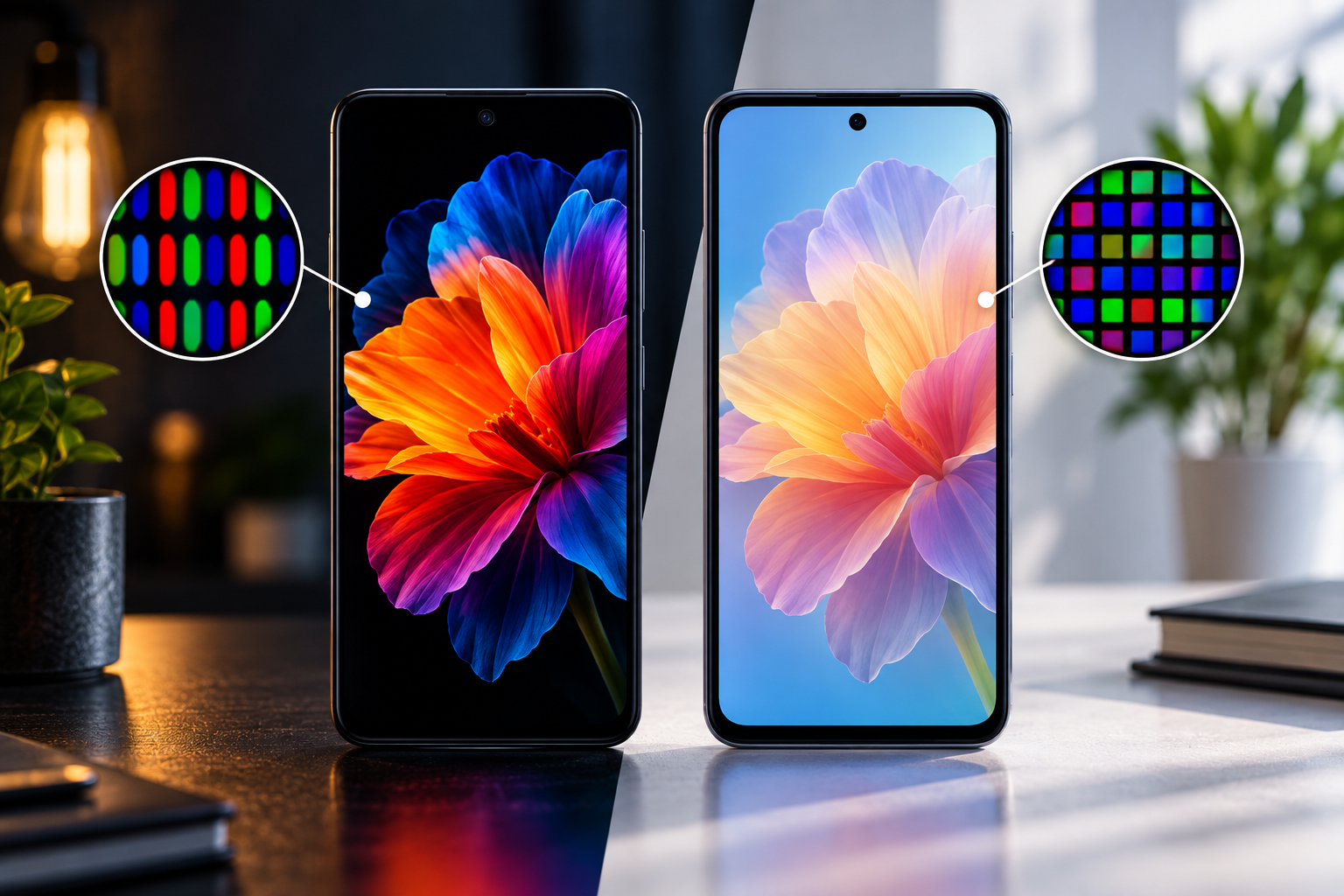
AMOLED vs LCD Display: Which Smartphone Screen Is Better?
When buying a new smartphone, you'll often see terms like:
AMOLED, OLED, Super AMOLED, LCD, IPS LCD, 120Hz, HDR and more.
For someone who isn't deeply familiar with smartphone specifications, it can be difficult to understand what all these terms actually mean.
One of the most common questions is:
AMOLED vs LCD—which one is better?
The short answer is:
AMOLED generally provides a better overall viewing experience, especially for movies, gaming, photography and dark-mode usage.
However, that doesn't mean every AMOLED display is automatically better than every LCD display.
Display quality depends on much more than the panel technology.
In this guide, we'll explain the difference between AMOLED and LCD displays, their advantages and disadvantages, battery impact, brightness, colors, viewing angles, durability and which one you should choose when buying a smartphone.
AMOLED vs LCD: Quick Comparison
| Feature | AMOLED | LCD |
|---|---|---|
| Black levels | Excellent | Good |
| Contrast | Excellent | Good |
| Colors | Usually vibrant | Usually natural |
| Viewing angles | Excellent | Good to very good |
| Battery efficiency | Can be excellent | Generally consistent |
| Dark mode efficiency | Excellent on OLED-type panels | Limited benefit |
| Burn-in risk | Possible | Very low |
| Cost | Generally higher | Generally lower |
| Premium phones | Very common | Less common |
| Budget phones | Increasingly common | Very common |
But these are general characteristics.
The actual quality depends on the specific display used by the manufacturer.
What Is an LCD Display?
LCD stands for:
Liquid Crystal Display
LCD screens use liquid crystals to control light from a separate backlight.
The pixels themselves don't produce their own light.
A simplified LCD structure works like this:
Backlight → Liquid Crystal Layer → Color Filters → Your Eyes
Because the backlight is always illuminating the display, producing completely black pixels is difficult.
This is one of the biggest differences between LCD and AMOLED.
What Is an AMOLED Display?
AMOLED stands for:
Active Matrix Organic Light-Emitting Diode
Unlike LCD, AMOLED pixels can produce their own light.
There isn't a traditional backlight illuminating the entire screen.
Each pixel can essentially be:
On → Producing light
or
Off → Producing no light
This is why AMOLED displays can produce extremely deep blacks.
And that difference creates several advantages.
AMOLED vs LCD: The Biggest Difference
The easiest way to understand the difference is to imagine a completely black image.
On an LCD:
The backlight is still operating behind the screen.
So black can look more like:
Dark grey
depending on the display.
On AMOLED:
Individual pixels can turn off.
So black areas can appear:
Deep black
This creates a much higher perceived contrast.
1. Black Levels
This is one area where AMOLED has a clear advantage.
Because AMOLED pixels can turn off individually, black areas can be extremely dark.
LCD panels still have a backlight operating behind the pixels.
Winner:
🏆 AMOLED
Especially noticeable when:
- Watching movies
- Using dark mode
- Viewing black backgrounds
- Looking at photos with high contrast
2. Contrast Ratio
Contrast refers to the difference between the darkest and brightest parts of an image.
AMOLED's ability to produce very deep blacks allows it to achieve extremely high contrast.
This can make images look more impactful.
For example:
A night scene in a movie can appear much more cinematic on a good AMOLED display.
Winner:
🏆 AMOLED
3. Colors
AMOLED displays are often known for vibrant colors.
Modern AMOLED panels can also be tuned for more natural-looking colors.
LCD displays can produce excellent colors too.
So you shouldn't assume:
AMOLED = always better colors
The actual result depends on:
- Panel quality
- Calibration
- Color profile
- Software tuning
A cheap AMOLED display can have poor calibration, while a high-quality LCD can look excellent.
Winner:
AMOLED — generally, but quality matters more than the label.
4. Brightness
This is where the comparison becomes more complicated.
Modern AMOLED displays can achieve very high brightness levels.
However, peak brightness figures don't tell the entire story.
Manufacturers may quote brightness under specific conditions, while real-world brightness can vary depending on:
- Screen area being illuminated
- Automatic brightness
- Ambient light
- Content
- Thermal conditions
- Display mode
Some high-quality LCD panels can also be extremely bright.
Winner:
Depends on the specific phone.
Don't buy a phone simply because it says AMOLED.
Check real-world reviews and measured brightness when outdoor visibility matters.
5. Viewing Angles
Viewing angle describes how well the display looks when you're not looking directly at it.
Good AMOLED displays generally maintain:
- Strong colors
- Good contrast
- Consistent image quality
when viewed from different angles.
LCD displays can also have good viewing angles, particularly high-quality IPS LCD panels.
Winner:
🏆 AMOLED
But the difference may not matter much during normal use.
6. Battery Life
This is one of the most misunderstood differences.
People often say:
"AMOLED always saves more battery."
That's not completely accurate.
AMOLED can be more power-efficient when displaying dark content because dark pixels can consume less power or be turned off entirely.
This is particularly useful when using:
Dark Mode
with lots of black elements.
LCD displays use a backlight, so changing a pixel from white to black doesn't eliminate the backlight's power consumption in the same way.
Example
Imagine a mostly black AMOLED interface.
Many pixels can remain off.
That can reduce display power consumption.
But if you're watching a mostly white webpage, the advantage can be much smaller.
Winner:
🏆 AMOLED for many dark-content scenarios
But overall phone battery life also depends on:
- Processor
- Battery capacity
- Refresh rate
- Brightness
- Software
- Network
- Apps
So don't expect an AMOLED phone to automatically have better battery life.
7. Dark Mode
If you love dark mode, AMOLED is particularly attractive.
Because black pixels can be turned off, dark interfaces can potentially use less display power.
You'll also get extremely deep blacks.
This can make:
- YouTube
- Chrome
- Messaging apps
- Settings
look excellent when using dark themes.
Winner:
🏆 AMOLED
8. Refresh Rate
Here's something important:
AMOLED and LCD describe the display technology.
Refresh rate is a separate specification.
You can have:
60Hz AMOLED
or
120Hz AMOLED
and you can also have:
60Hz LCD
or
120Hz LCD
A higher refresh rate can make scrolling and animations appear smoother.
So don't confuse:
AMOLED vs LCD
with:
60Hz vs 120Hz
They're different characteristics.
9. Touch Response
Display technology isn't the only factor affecting touch response.
Touch performance depends on the specific panel and phone implementation.
Modern smartphones with both AMOLED and LCD displays can offer excellent touch responsiveness.
For gaming, look at:
- Touch sampling rate
- Touch latency
- Software optimization
- Processor performance
rather than simply choosing AMOLED.
10. HDR Content
HDR stands for:
High Dynamic Range
HDR can improve the difference between bright and dark areas of supported content.
A good AMOLED display can provide an excellent HDR viewing experience because of its:
- High contrast
- Deep blacks
- Strong brightness
However, simply having an AMOLED screen doesn't automatically mean the phone provides excellent HDR.
The phone also needs appropriate:
- HDR support
- Brightness
- Color reproduction
- Software support
- Streaming compatibility
Winner:
🏆 Good AMOLED
11. Screen Burn-In
This is one of the biggest disadvantages associated with AMOLED displays.
AMOLED pixels can degrade over time.
If the same static element remains on the screen for very long periods, it can potentially cause:
Image retention or burn-in
For example, static elements such as:
- Navigation buttons
- Status-bar icons
- Channel logos
- UI elements
may contribute to uneven pixel wear over very long periods.
Modern phones use various techniques to reduce this risk.
Still, the possibility exists.
LCD advantage:
LCD displays generally don't have the same OLED burn-in characteristic.
Winner:
🏆 LCD
12. Durability
Neither AMOLED nor LCD automatically makes a phone durable.
The overall durability depends on:
- Glass protection
- Frame
- Construction
- Display assembly
- Phone design
An AMOLED panel doesn't mean the phone is fragile.
Likewise, LCD doesn't automatically mean the phone is stronger.
Winner:
Depends on the device.
13. Thickness and Design
AMOLED technology can allow manufacturers to create thin display assemblies and flexible screens.
This has helped manufacturers build:
- Slim smartphones
- Curved displays
- Foldable phones
- Edge-to-edge designs
LCD can also be implemented in thin designs, but AMOLED has played a major role in modern premium smartphone design.
Winner:
🏆 AMOLED
14. Price
LCD displays have historically been cheaper to manufacture and have therefore been widely used in affordable smartphones.
AMOLED panels have become increasingly common at lower price points, but premium AMOLED panels can still increase device costs.
This is why you may see:
LCD → Budget-focused phones
and:
AMOLED → Mid-range and premium phones
although the boundaries are becoming less strict.
AMOLED vs LCD for Gaming
If you are a mobile gamer, should you automatically choose AMOLED?
Not necessarily.
For gaming, consider:
Processor
The processor determines much of the game's performance.
Refresh Rate
A higher refresh rate can provide smoother motion.
Touch Response
Low touch latency is important.
Thermal Management
A phone that overheats can reduce performance.
Battery
Long gaming sessions require good battery life.
AMOLED can make games look fantastic because of its contrast and colors.
But:
A powerful LCD phone can still be a better gaming phone than a weak AMOLED phone.
AMOLED vs LCD for Watching Movies
This is one category where AMOLED usually shines.
Imagine a movie scene with:
- A dark night sky
- Bright stars
- Shadows
- Bright lights
AMOLED's deep blacks and high contrast can make the scene look more immersive.
Winner:
🏆 AMOLED
AMOLED vs LCD for Photography
If you edit or view photos on your phone, AMOLED can make images look vibrant and punchy.
But there's a catch.
An extremely saturated display isn't necessarily more accurate.
If you care about photography, look for:
- Color accuracy
- Display calibration
- Wide color gamut
- Brightness
- HDR support
Winner:
Depends on display quality and calibration.
AMOLED vs LCD for Reading
This is more subjective.
Some people prefer AMOLED because of its contrast and deep blacks.
Others prefer a good LCD because it can provide a more natural-looking image.
For long reading sessions, also consider:
- Brightness
- PWM behavior
- Refresh rate
- Font rendering
- Eye comfort features
Don't choose a display technology based solely on the AMOLED/LCD label.
What Is OLED?
You may have noticed another term:
OLED
OLED stands for:
Organic Light-Emitting Diode
AMOLED is a type of OLED display technology that uses an active-matrix backplane.
In simple terms:
OLED → Broad display technology family
AMOLED → A type of OLED implementation
For smartphone buyers, you don't necessarily need to understand every technical detail.
The important thing is that OLED-type displays can control individual pixels and therefore produce very deep blacks.
What Is Super AMOLED?
You may also see:
Super AMOLED
This is a branding term used for certain Samsung display implementations.
The exact technical characteristics depend on the specific panel and device.
Don't assume:
Super AMOLED = automatically the best smartphone display.
Always evaluate the actual display quality.
AMOLED vs LCD: Which One Should You Buy?
Here's the simple answer.
Choose AMOLED if you:
- Watch lots of movies
- Use dark mode
- Want deep blacks
- Prefer high contrast
- Want a premium display experience
- Play games
- Enjoy vibrant visuals
Choose LCD if you:
- Want to save money
- Find a phone with an excellent LCD panel
- Prefer a particular color profile
- Want to minimize concerns around OLED burn-in
- Don't care much about deep blacks
Is AMOLED Worth Paying More For?
For many users:
Yes.
If two phones are similarly matched in:
- Processor
- Camera
- Battery
- Software
- Storage
and one has a significantly better AMOLED display, the AMOLED model can be worth considering.
But don't sacrifice major hardware improvements simply to get AMOLED.
For example:
Phone A: Excellent processor + LCD
Phone B: Weak processor + AMOLED
For a gamer, Phone A may be the better purchase.
AMOLED vs LCD: What Matters More?
When comparing smartphone displays, don't stop at the panel type.
Look at these specifications together:
1. Panel Technology
AMOLED / OLED / LCD
2. Resolution
For example, Full HD+
3. Refresh Rate
60Hz / 90Hz / 120Hz+
4. Brightness
Important for outdoor use.
5. Color Accuracy
Important for photography and creative work.
6. HDR
Useful for supported content.
7. Touch Response
Important for gaming.
8. PWM / Flicker Behavior
Important for users who are sensitive to display flicker.
9. Screen Protection
Important for durability.
This is a much better way to evaluate a phone.
AMOLED vs LCD: Common Myths
Myth 1: Every AMOLED Is Better Than Every LCD
False.
A high-quality LCD can outperform a poor AMOLED panel in certain areas.
Myth 2: AMOLED Always Saves Battery
False.
Battery savings depend heavily on the content displayed, brightness, refresh rate and other factors.
Myth 3: More Saturated Colors Mean Better Display
Not necessarily.
Accurate colors can sometimes look less dramatic than heavily saturated colors.
Myth 4: LCD Is an Old and Bad Technology
False.
High-quality LCD panels can still provide excellent brightness, color accuracy and viewing experiences.
Myth 5: AMOLED Screens Always Get Burn-In
False.
Burn-in is a potential long-term risk, but modern displays use techniques designed to reduce it.
AMOLED vs LCD: Final Comparison
| Category | Better Choice |
|---|---|
| Deep Blacks | AMOLED |
| Contrast | AMOLED |
| Dark Mode | AMOLED |
| Movie Watching | AMOLED |
| Premium Look | AMOLED |
| Viewing Angles | AMOLED |
| Burn-in Resistance | LCD |
| Budget Pricing | LCD |
| Overall Experience | Usually AMOLED |
| Value | Depends on Phone |
Final Verdict
So, AMOLED vs LCD—which display is better?
For most people, I'd choose:
🏆 AMOLED
because of its:
- Deep blacks
- High contrast
- Excellent viewing experience
- Strong colors
- Dark-mode efficiency
- Premium appearance
But here's the most important point:
Don't buy a smartphone simply because it has an AMOLED display.
A display is only one part of the phone.
Before buying, compare the processor, camera, battery, software support, brightness, refresh rate and actual display quality as well.
A great smartphone isn't built around one impressive specification.
It's the combination of several good decisions.